

When ROAS is lower and profit is higher
 Leonid Tondrykov, founder of Magic · 8 min read
Contents
To me, a case study is a challenge we overcame
Hi. I'm Leonid, founder of Magic.
“Put in 10 thousand, made 100” — I don't call that a case study.
Numbers like these come up almost daily in our work. Stories worth sharing come along once every 3 months, six months or a year.
How does it work in practice? GUD came to us at point A. Together we got to point B. It became the new point A, and we moved on.
That is how the brand grew 10 times. On the way to each point B we went through different challenges.
Today I'll tell you about one of them: finances.
Case studyFinancesHow we stopped holding on to ROAS and grew the brand's profit one and a half times.Read on ↓Leonid Tondrykov, founder and CEO of Magic
GUD is a Ukrainian backpack and bag brand
They have been sewing durable backpacks and bags at their in‑house production in Kyiv since 2012.
For a long time the brand's income rested on B2B. GUD came to us to grow sales directly to consumers. We have been working together for 2 years.

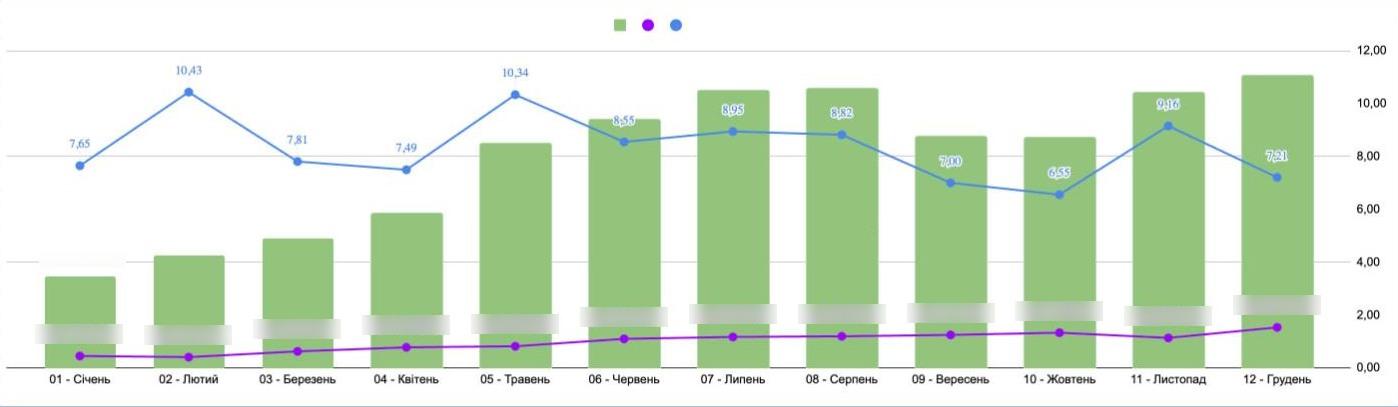
Here is how the brand grew month by month.
Green bars are revenue, the blue line is ROAS, the purple line is ad budget. Amounts are hidden. Labels in the screenshot are in Ukrainian.
The challenge
After a year and a half of work we hit a revenue ceiling. We reached a peak at ROAS 8 and could not break through it for three months. We did a lot and everything worked well, but the numbers did not grow.
I saw the team holding on to ROAS and the client worrying every time it dipped. I said more than once that you can earn more with a lower ROAS. But it was hard to prove in words alone.
The finance specialist's calculator
At that time the client was putting their finances in order together with a finance specialist. We reached out to him, talked, and he promised to build a calculator for us. And he did.
I ran every month from the start of the year to May through that calculator. And I saw a pattern: when ROAS was a little lower, profit could be higher. Now it was visible in real numbers.
The agreement for May
The team and I met with the client and agreed: in May we deliberately lower the bar on ROAS in order to scale.
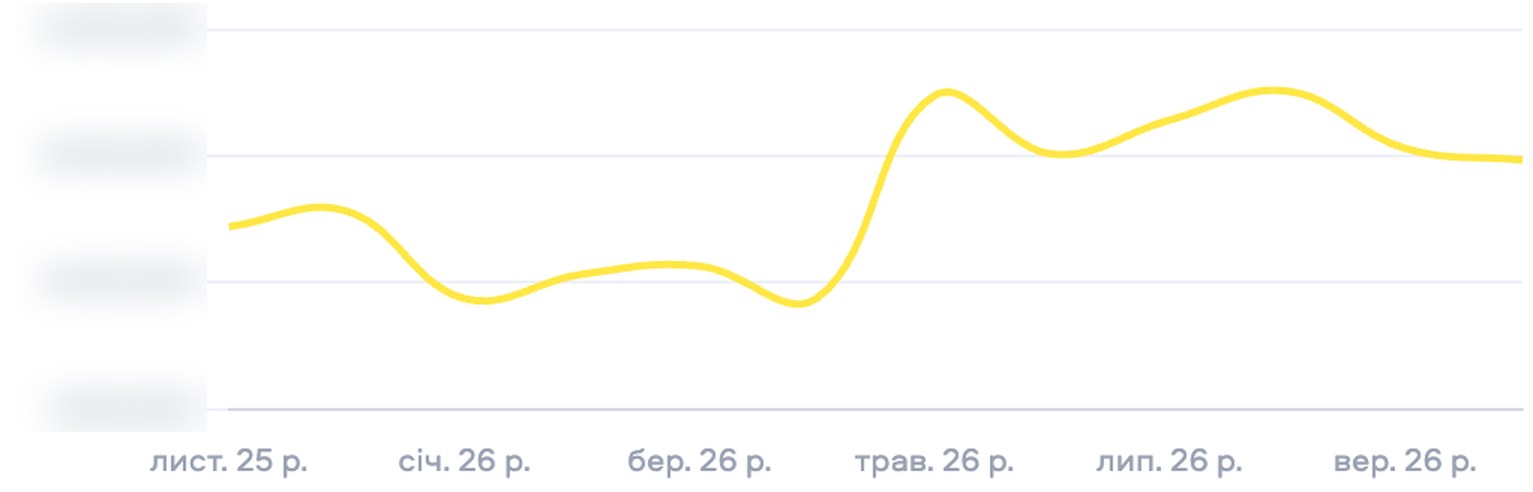
Revenue by month from our dashboard.
May: we broke the ceiling
Revenue almost ×2, profit ×1.5
Almost twice as high as the ceiling we had been hitting for three months.
Grew about 1.5 times.
Went down a little: from 8 to 6.
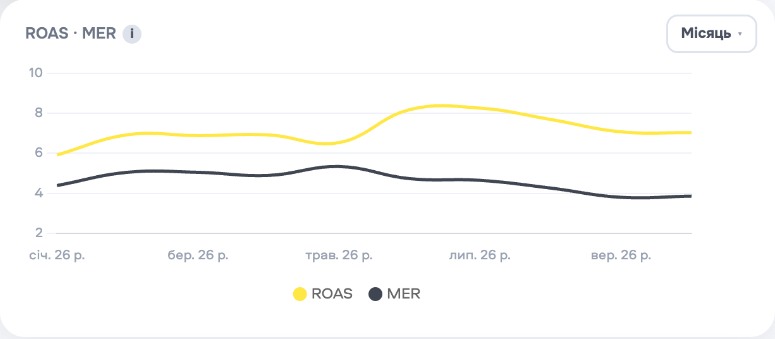
ROAS and MER by month in 2026, from our dashboard.
Stop focusing on ROAS
Most people look only at ROAS and try to push it up. The main metric in this case study is gross profit.
ROAS can be lower while the business earns more. At first glance it sounds illogical, but in practice that is exactly how it works.
To work this way you need to know your margin precisely: where the money goes, what the product itself costs, its production and packaging. We calculate this for every item and take the average across the whole range.
How we calculate profit
We build the whole strategy on this cascade.
How it is calculated
Margin is the money left from a sale after cost of goods and order costs: delivery, commissions, unclaimed orders. Revenue = ads × ROAS.
Put less into ads: ROAS is higher, but there is less profit. Put in more: ROAS is lower, but there is more profit. Figures are arbitrary.
- Week 1 → 2. More ads, lower ROAS, more gross profit.
- Forecast. Even more budget: ROAS keeps falling, and profit grows a little more.
- The limit. When gross profit starts to fall, we stop raising the budget.
| Ads | ROAS | Gross profit | |
|---|---|---|---|
| Week 1 | 75 | 8.71 | 385 |
| Week 2 | 111 | 6.79 | +30415 |
| Forecast: budget ×1.4 | 150 | 5.5 | +13428 |
| Forecast: budget ×2.3 | 250 | 3.6 | −48380 |
More profit with a lower ROAS is better than a high ROAS with no growth.
So is ROAS not needed at all?
It is. It helps us with two things.
- It shows the trend in ads. We compare ROAS with gross profit. That way it is clear right away when it is the ads that are slipping, not the whole business. During scaling ROAS goes down as expected, say to 3. If it keeps falling and drags profit down with it, we see it on the chart and react quickly.
- It separates ads from the rest of marketing. If you look only at MER, a week or a month can look like a failure because of a payment to an influencer, an integration or a content creator's work. You might think the ads broke and make mistakes. But ROAS is holding, so the ads are fine.
After May ROAS went up again and reached 8.3 in the summer. A lower target does not mean we gave up on it. If ROAS can be improved, we improve it. But gross profit always comes first.
Sometimes companies come with the request “let's lock in ROAS 8 and hold on to it.” That approach is not for us: we work with those who want to keep scaling. Byron Sharp's research also confirms that fixating on holding a metric leads nowhere.
The finance specialist calculated the break-even ROAS for us and helped set up the calculations. More on this: how to calculate ROAS. You can calculate your own break-even ROAS in the calculator.
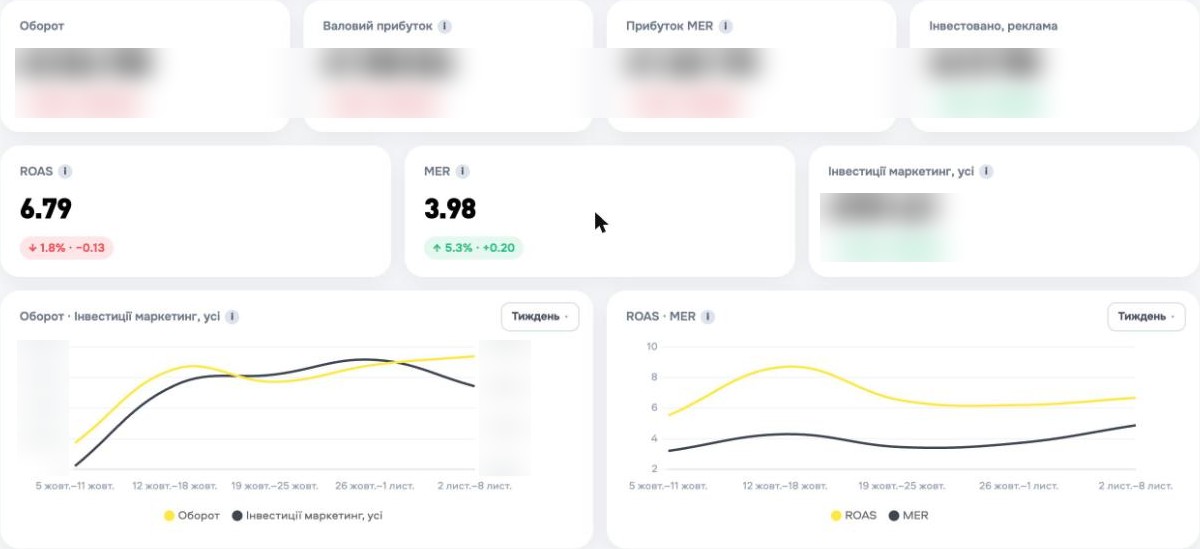
How we work every week
ROAS matters. But it always falls when you scale
- 01 · We scaleROAS falls, the customer base grows
- 02 · We optimizeOn a loyal base we bring ROAS back up
- 03 · We don't stand stillA long pause: customers leave for competitors, purchases fall
Loyalty grows together with the customer base, according to Byron Sharp. The diagram has no figures.
Result
revenue in two years
revenue in a month after the target change
premises this year
Ihor is less involved in the processes. The plan for this month is another ×2
A review from Ihor, owner of GUD
About working with us. Unscripted and unedited.
“For me it is very important that the agency has become partners for us who truly care about the result.”
Ihor Gud, owner of GUD · from the video, 2:28
What any store owner can apply
- 01
Look at profit first
Base every decision on it.
- 02
Put the numbers together with a finance specialist
That is how you see the real picture of your profit.
Questions
Why can ROAS be lower while profit is higher?
It all comes down to volume. When ROAS is lower but revenue is much higher, the brand earns more. At GUD, lowering the target from ROAS 8 to 6 almost doubled revenue in a month.
If you lower the target ROAS, does efficiency stop mattering?
It matters a great deal. If ROAS can be improved, we improve it. At GUD it went up again after May. But gross profit always comes first.
How do you scale an ad budget?
Raise it to the volume you need and refresh creatives on time.
Why can't you judge ads by the ad account alone?
The ad account does not show real profit. We judge the result by the CRM and the profit numbers.
Other challenges we overcame at GUD
Each of them is a separate case study. We are still writing these stories, and they will appear here soon.
We'll find where your store is losing money. In 90 minutes
A free diagnostic session with the founder of Magic: your ad accounts, analytics and CRM on screen, 2–3 decisions your team can implement on its own within a week. No slides and no sales pitch.